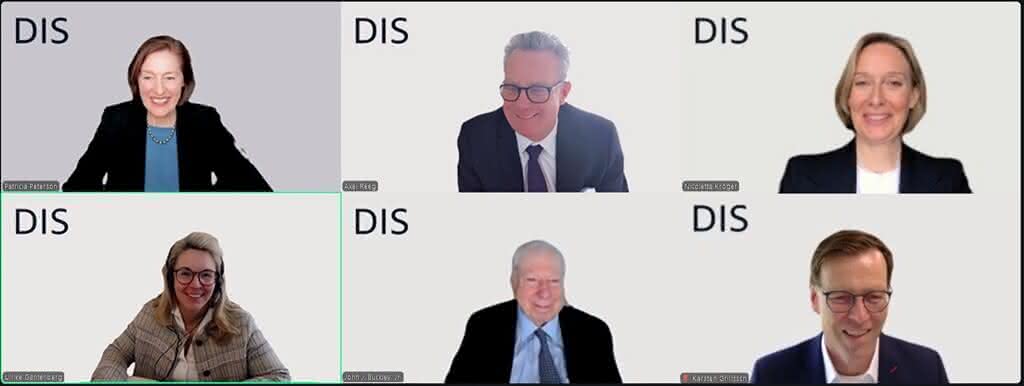
The role and practical impact of Article 26 of the DIS Rules in international arbitration, including different approaches and international best practices in settlement facilitation was the focus in the latest session of the Lunch DIScussions, where John J Buckley, Jr, Ulrike Gantenberg, Nicoletta Kröger, Patricia Peterson, and Axel Reeg shared their thoughts.
The discussion was based on the key findings of the DIS Rules Clinic on Settlement Facilitation. For anyone interested in exploring the topic further, the full Report of the DIS Rules Clinic is available on the DIS website.
Direct settlement facilitation is still perceived very differently across jurisdictions and is not equally accepted in every country. While some legal systems and arbitration rules expressly encourage tribunals to support settlement discussions, this often remains underused in practice.
At the same time, the international arbitration community does not operate without guidance. Existing soft laws and guidelines on the topic already exist, including the 2009 CEDR Commission Report, the IMI Mixed Modes Task Force materials, Standard 4(d) of the IBA Guidelines on Conflicts of Interest, and the Ciarb Guideline on the Use of Mediation in Arbitration.
One interesting takeaway from the discussion was that many international users still tend to label direct settlement facilitation simply as the “German approach”, sometimes without fully appreciating its broader international context and safeguards. The panelists emphasised that successful settlement facilitation requires, above all, the parties’ clear consent, the right timing – for example after the first round of substantive submissions in front-loaded proceedings – and careful preparation and guidance by the tribunal. They also stressed the importance of transparent communication about the process and next steps, always with the parties’ agreement, and made clear that tribunals should never switch roles from arbitrator to mediator or engage in caucusing with the parties.
Where direct settlement facilitation is inappropriate – whether because a party does not want it or because the arbitrators lack the skills or experience to do it well or other – a tribunal can still take steps to assist the parties in settling their case. These techniques should be viewed as fulfilment of an arbitrator’s duty under Article 26 of the DIS Rules.
Buckley shared his experience as a common law counsel confronted with a German-style active settlement facilitation approach by a tribunal. He highlighted the importance of communication with the tribunal, including consideration of intercultural differences. Active settlement facilitation requires arbitrators who are knowledgeable about, and experienced in, settlement facilitation of this kind. He concluded that the trend is for arbitrators to take a more proactive role in encouraging settlement.
Karsten Grillitsch