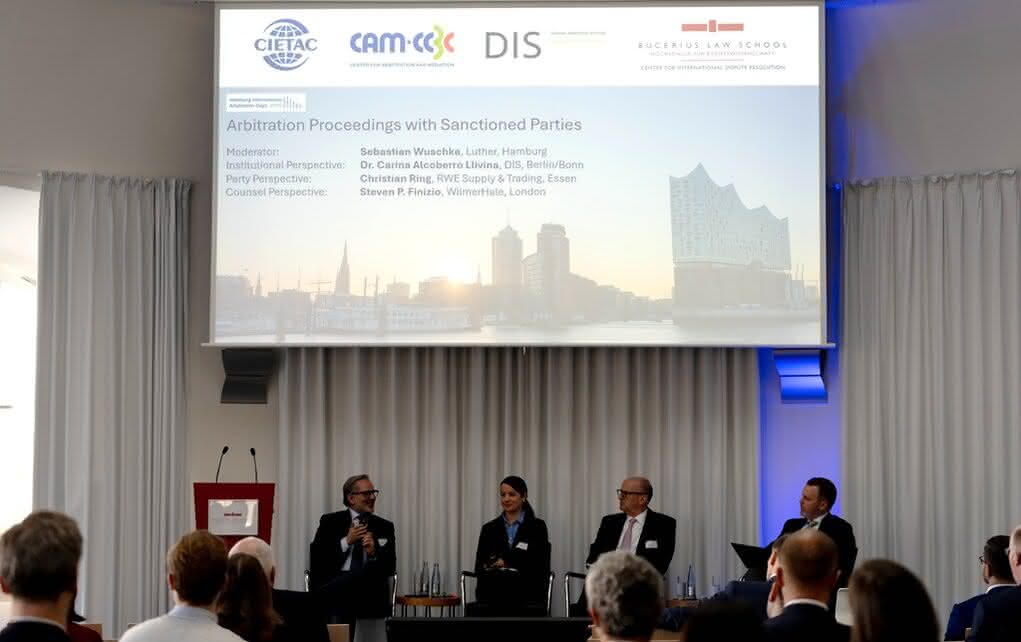
DIS, CIETAC, CAM-CCBC and the Bucerius Center for International Dispute Resolution jointly organised a half-day conference on 23 March 2026, hosted by the Bucerius Law School in Hamburg and entitled Arbitration and Enforcement Proceedings in the Age of EU Sanctions and the Russian Lugovoy Law.
The event formed part of the Hamburg International Arbitration Days 2026 and addressed topics of growing practical importance for international arbitration: the impact of sanctions in particular, Russia’s Lugovoy Law and related retaliatory litigation measures on the conduct, effectiveness and enforcement of arbitral proceedings.
The first panel, moderated by Sebastian Wuschka (Luther) focused on the practical challenges that may arise throughout the lifecycle of arbitration involving sanctioned parties. Carina Alcoberro, DIS Compliance Officer, contributed an institutional perspective and discussed the implications of the rapidly evolving sanctions environment for arbitral institutions, including compliance checks, payment restrictions, service issues and the handling of defaulting parties. Christian Ring (RWE Supply & Trading) provided the party perspective, while Steven P. Finizio (WilmerHale), addressed issues from the counsel perspective. The discussion highlighted the need to preserve access to neutral dispute resolution fora while ensuring compliance with applicable sanctions regimes.
The second panel turned to the enforcement of Russian judgments under the Lugovoy Law in BRICS states. Moderated by Stefan Kröll (Bucerius Law School / DIS Board Member), the panel included contributions from: Viktor Gerbutov (Noerr) on the Lugovoy Law; Ajar Rab (ANR LAW LLP) on enforcement in India; Jingzhou Tao (Avocat à la Cour de Paris) on enforcement in China; and Claudio Finkelstein (Pontifical Catholic University of São Paulo) on enforcement in Brazil. The discussion delivered comparative insights into how Russian judgments and related enforcement strategies are currently treated in these jurisdictions and what future developments may be expected.
The conference was particularly timely, as demonstrated by the EU’s 20th sanctions package, which entered into force exactly one month after the conference and whose implications are discussed in another contribution to this newsletter. Against this background, the event offered a valuable and practice-oriented exchange on the intersection of sanctions, arbitration and enforcement in an increasingly fragmented legal environment.
Carina Alcoberro